1) Unha é coller un ferry en Hirtshals (Dinamarca) ata Kristiansand (Noruega). É máis directo, pero tamén máis caro e non pasas por Copenhage. Prezo segundo os moteiros bascos: 24.000 pts (144 euros). Confirmei o prezo actual na páxina:
http://www.aferry.es/timetable/HirtshalsKristiansandColorLinees.htm
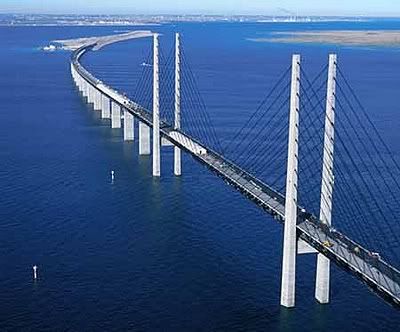
2) Outra opción é dar un rodeo e atravesar dúas pontes con peaxe. Unha une a península de Fionia (continente) coa illa de Seeland, onde está Copenhage. Esta ruta permite visitar esta capital. A segunda ponte une Copenhage con Suecia e é unha das máis (ou a máis) longas de Europa.
Primeira ponte: 30 + 30 euros (ida + volta) = 60 euros.
Segunda ponte: 40 + 40 euros (ida + volta) = 80 euros.
Fotos e información sobre as pontes en:
http://www.storebaelt.dk/english/bridge
Visualizar o mapa ampliado
Denmark consists of the Jutland peninsula and more than 400 islands of which the largest are Zealand and Funen. Copenhagen, Denmark's capital, is located on Zealand.
Among the many ferry routes which have linked the Danish islands for centuries, by far the most important has been the route across the Great Belt between Funen and Zealand. Over the years, however, storms and hard winters have frequently disrupted ferry services across the Great Belt.
On June 10, 1987 the Danish Parliament approved the construction of a fixed link across the Great Belt. Following 12 years of intensive construction work, H.M. Queen Margrethe II of Denmark inaugurated on June 14, 1998 what had then become the largest engineering project in the history of Denmark, The Great Belt Fixed Link.
The Link comprises the East Bridge, a 6,790 m long suspension bridge between Zealand and the small island of Sprogø, a 6,611 m long combined rail and road bridge between Sprogø and Funen and an 8,000 m long immersed rail tunnel between Zealand and Sprogø.
At 254 m above sea level, the East Bridge's two pylons are the highest points in Denmark.
Segunda ponte: Bridge between Sweden and Copenhagen (Danemark): 38 € toll

3) Terceira opción: Ferry desde Puttgarden (Alemaña) a Rodbyhavn (Dinamarca), seguindo a autoestrada E47. Prezo: 56 euros (ida); evitamos a primeira das pontes, entre o continente e a illa de Seeland. Ruta máis curta:
Info sobre esta ruta en:
The Rodbyhavn - Puttgarden ferry is the shortest way between islands of Denmark and Germany. We spent only an hour to reach from Denmark to Germany, including 15 minutes of waiting for loading on the ferry and 45 minutes of navigation through the Fehmarn Belt strait.
Ferries on a route Denmark-Germany: Rodbyhavn-Puttgarden - "Deutschland", " Pins Richard " have an autodeck, restaurants of a various category, including for drivers, bars, shops, a children's room, a video-hall, meeting rooms.
Rødby – Puttgarden: 56Euros for car
Crossing: 45 minuttes
Departure: Every 30 minuttes
Check-in: No later than 15 minuttes before departure
Contact Scandlines at 


 +45 33 ...
 for further information.
http://www.english.scandlines.dk/DKFront/Front_COM


No hay comentarios:
Publicar un comentario